Ameren Power Smart Pricing: Turning Hourly Rates Into Savings
Most utilities use time-of-use pricing: fixed price blocks that are the same every day. Ameren Illinois’s Power Smart Pricing program is different, and it’s worth understanding, because it rewards automation more than almost any rate in downstate Illinois. Instead of a few fixed blocks, you pay the actual hourly wholesale market price, and that price changes every hour, every day.
This guide explains how Power Smart Pricing works, why it’s a great fit for a smart home, and how to capture the savings you can’t realistically chase by hand.
How Power Smart Pricing works
On Ameren’s standard rate, you pay one supply price no matter when you use power. On Power Smart Pricing, you pay the hourly wholesale market price set by the regional grid operator (MISO), plus the same delivery charges, taxes, and fees every Ameren customer pays.
Two things make this different from time-of-use:
- The price changes daily. Tomorrow’s hourly prices are published the afternoon before, so a cheap 2 a.m. tonight might be a different number tomorrow. There’s no fixed schedule to memorize.
- The swings can be large. Overnight and midday hours are often just a few cents per kilowatt-hour of wholesale cost; hot summer evenings can spike well above that. The shape of the curve is different every day.
What the hourly price actually does across a day
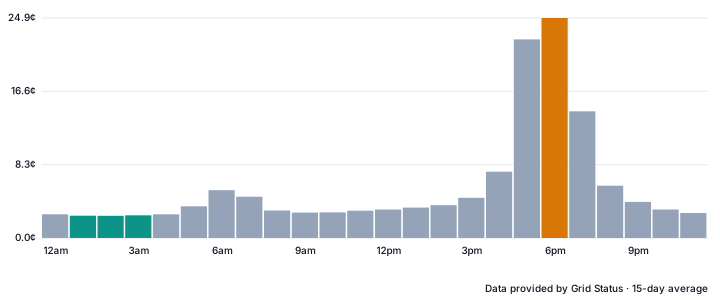
Hourly averages as a table
| Hour | Average ¢/kWh |
|---|
“No fixed schedule” is true, but it is not the same as “no pattern.” The hourly price is set by supply and demand on the MISO market, and both follow the clock more closely than the day-to-day variation suggests. A typical Illinois weekday runs roughly like this:
| Hours | What is happening on the grid | Typical shape |
|---|---|---|
| Midnight – 6 a.m. | Demand at its daily floor; wind output often at its highest | The cheapest stretch most nights |
| 6 – 9 a.m. | Morning ramp as homes and businesses wake up | Rising |
| 9 a.m. – 3 p.m. | Solar contributes, industrial load is steady | Moderate, sometimes a midday dip |
| 3 – 7 p.m. | Air conditioning peaks as solar falls away | The most expensive stretch |
| 7 p.m. – midnight | Demand unwinds through the evening | Falling back toward the overnight floor |
The important qualifier is that this is a tendency, not a timetable. The overnight trough might land at 1 a.m. tonight and 4 a.m. tomorrow. A windy spring night can push prices near zero for hours; a still, humid July evening can put the 5 p.m. hour an order of magnitude above the 3 a.m. one. Mild shoulder-season days can be nearly flat, with barely enough spread to be worth acting on.
Three things move the curve more than anything else:
- Temperature, because air conditioning is the largest swing load on a summer grid. A 95°F day and a 78°F day produce very different evening prices.
- Wind, because MISO carries a large wind fleet. Strong overnight wind is the usual reason prices collapse in the small hours.
- The day of the week, because commercial and industrial demand drops at weekends — which is why Saturday afternoons are often cheaper than Wednesday ones.
What this means in practice: you cannot set one timer and be done, but you also cannot ignore the shape. The reliable strategy is to keep large flexible loads out of the late-afternoon block and push them toward the overnight trough — then adjust the exact hour against the prices published the day before. That is a small daily decision with real money attached, and it is precisely the kind of decision people stop making after a few weeks.
If this sounds familiar, it should: it’s the same wholesale-pass-through idea as ComEd’s Hourly Pricing up in northern Illinois. Both programs exist because of the Illinois Power Agency Act, which required the state’s big utilities to offer residential real-time pricing. The main difference is geography — Power Smart Pricing serves Ameren’s central and southern Illinois territory and settles on Ameren’s zone of the MISO market, while ComEd’s program covers the Chicago area on the PJM market.
That’s the opportunity and the problem in one sentence: the savings are real, but they move.
Where the savings are
Because the cheapest hours shift day to day, the wins come from reacting to each day’s price curve:
- EV charging during whatever the cheapest overnight stretch happens to be tonight. Not a fixed “after midnight” rule, but the actual low point.
- Pre-cooling or pre-heating ahead of the hours your forecast says will be expensive, so your HVAC coasts through the spike.
- Water heating and battery charging timed to the day’s troughs and away from its peaks.
On a fixed time-of-use plan, “off-peak” is the same every day and you can set a static timer. On Power Smart Pricing, the best schedule is genuinely different tomorrow than it was today, which is exactly why a static timer leaves money on the table.
How to capture it: by hand vs. automatically
By hand, you’d check tomorrow’s published hourly prices each afternoon, cross-reference the weather, and reprogram your thermostat, EV charger, and water heater accordingly — every day. Almost nobody sustains that. And even if you did, you’d still be eyeballing how much pre-cooling your house actually needs.
Automatically is the whole point of a rate like this. Hungry Machines pulls the next day’s hourly prices, combines them with tomorrow’s forecast plus a custom model of your home, then builds an optimized schedule each night. It charges the EV in the genuine overnight trough, pre-cools just enough to skate past the expensive hours, and times your water heater and battery to the day’s cheapest energy. Then it does everything again tomorrow against tomorrow’s new prices.
In this situation, automation is the only realistic way to capture what the rate offers.
If you are on hourly pricing, with or without a battery, Hungry Machines for Illinois hourly pricing walks through what changes when the price moves every hour. For the mechanics of pre-cooling, and why it needs a model of your house rather than a rule about the clock, see automating your HVAC for time-of-use savings.
Do peak rates apply on weekends?
On Power Smart Pricing the question doesn’t apply — there is no peak window at all. The program has no fixed afternoon block, no weekday/weekend split, and no calendar rule of any kind. Saturday at 6 p.m. is priced by that hour’s wholesale market, exactly like every other hour.
That is a real difference from a time-of-use plan, not a technicality. On a fixed plan you can answer “when is power expensive?” once and set a timer. On Power Smart Pricing the expensive hours are wherever demand and generation put them that day — and weekend afternoons are often cheaper than weekday ones, because commercial and industrial demand across the MISO footprint drops.
So the honest guidance inverts. Rather than memorising a window, you want tomorrow’s hourly prices, which Ameren publishes the afternoon before. The cheapest weekend hour and the cheapest weekday hour are found the same way: by reading the curve. That is a daily task, which is why it suits automation rather than habit.
Common questions
Is Power Smart Pricing risky?
Your price follows the MISO wholesale market, so a rare spike costs more in that hour. Power Smart Pricing publishes tools and price alerts precisely so those days don’t surprise you, and the program has run since 2007 — this is a mature offering, not an experiment.
The exposure is narrower than it sounds. Spikes concentrate in a handful of hot summer evening hours, and in exchange you pay genuine wholesale cost the rest of the year, which is usually well under the fixed supply rate. Participants who shift load away from those hours are the ones who come out ahead.
The honest version: on the standard rate you cannot lose to a price spike. If your household has no flexible load and no intention of automating anything, the fixed rate is the safer choice and there is no shame in it.
How is this different from time-of-use?
Time-of-use has fixed daily price blocks — a California utility’s 4–9 p.m. peak is the same 4–9 p.m. tomorrow, next week, and next July. Learn it once, set a timer, and you are roughly right forever.
Power Smart Pricing has a brand-new price for all 24 hours, published the afternoon before. There is no schedule to memorise because there is no schedule. Tonight’s cheapest hour might be 2 a.m.; tomorrow it might be 11 a.m., because wind across the MISO footprint is strong and demand is soft.
That changes what a good strategy looks like. On time-of-use, a static timer captures most of what’s available. Here it captures some and misses the rest, because it has no way to know that tomorrow’s trough moved six hours.
Do I need an EV or battery to benefit?
No, though they help most. An EV is close to the perfect load for this rate: large, entirely flexible about when it charges, and needing the same kilowatt-hours either way. Moving a 40 kWh charge out of an expensive evening and into an overnight trough is about as close to free money as home energy gets.
But pre-cooling a home with central AC captures meaningful savings on its own. Your house is already a thermal battery — cool it while power is cheap and it coasts through the expensive hours, no hardware purchase required. An electric water heater does the same trick with hot water.
What decides the benefit isn’t which appliance you own. It’s how much of your consumption is time-flexible. A home running mostly lights and electronics has little to shift, whatever is parked in the garage.
Next steps
Up in the Chicago area instead? The same playbook applies to ComEd’s Hourly Pricing. If your utility uses fixed time-of-use blocks rather than hourly prices, our time-of-use rates guide is the place to start. And for the wider picture on the software that does this automatically, see what a home energy management system actually does.
To let your home react to Ameren’s hourly prices automatically, see how Hungry Machines works and sign up now.
For the cross-utility picture, see the cheapest time to run your appliances and whether peak rates apply on weekends.