We Measured a Summer of ComEd's Day-Ahead Prices Against the Real-Time Prices You're Billed
If you’re on ComEd Hourly Pricing, two prices matter every day: the hourly curve published the afternoon before, and the real-time price you are actually billed. Our earlier post covered how the rate works. This one asks a narrower question: how far apart do those two prices get, and what does the gap cost a household that plans around the forecast?
We pulled the data for every hour from June 1 to September 3, 2026 — 84 complete days — and compared them.
Most hours, the forecast is good
The boring finding comes first, because it is most of the picture. The median gap between the day-ahead and the billed real-time price was 0.7¢/kWh. Averages sat close too: 5.2¢ forecast, 5.5¢ billed. If you shifted four hours of flexible load into the forecast’s cheapest hours each day, your median penalty against a perfect after-the-fact pick was 0.12¢ per shifted kWh. On 76 of the 84 days, planning on the forecast was within a cent of optimal or better.
The other days are where the money is
The forecast fails in one specific way: it underprices spikes. Ninety-two hours that summer settled at 14¢/kWh or more — the threshold ComEd’s own price alerts use. The day-ahead forecast priced 48% of those hours below 14¢, and 15% of them below 8¢, which is to say: cheap. Those fully blind hours averaged 21.9¢ and reached 46.9¢, and they landed about once a week, always between 9 a.m. and 8 p.m.
July 3 was the summer’s biggest delta:
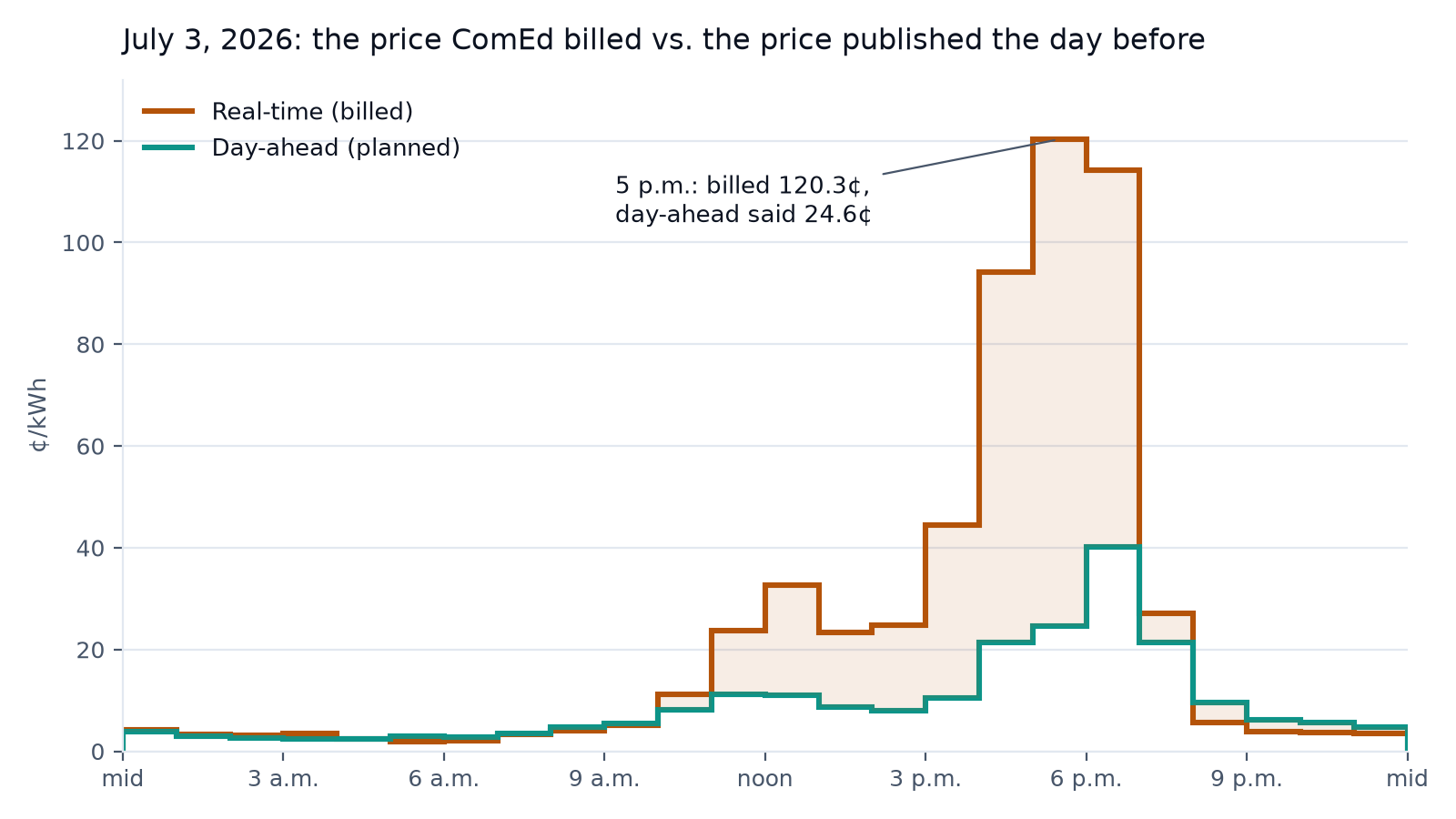
The forecast did warn that the evening would be expensive, which helps — anything scheduled around the forecast had already fled the 6 p.m. hour. The damage came from midday: hours the forecast priced at an ordinary 8–11¢ settled between 23¢ and 44¢.
The other thing the data shows is how concentrated these misses are:
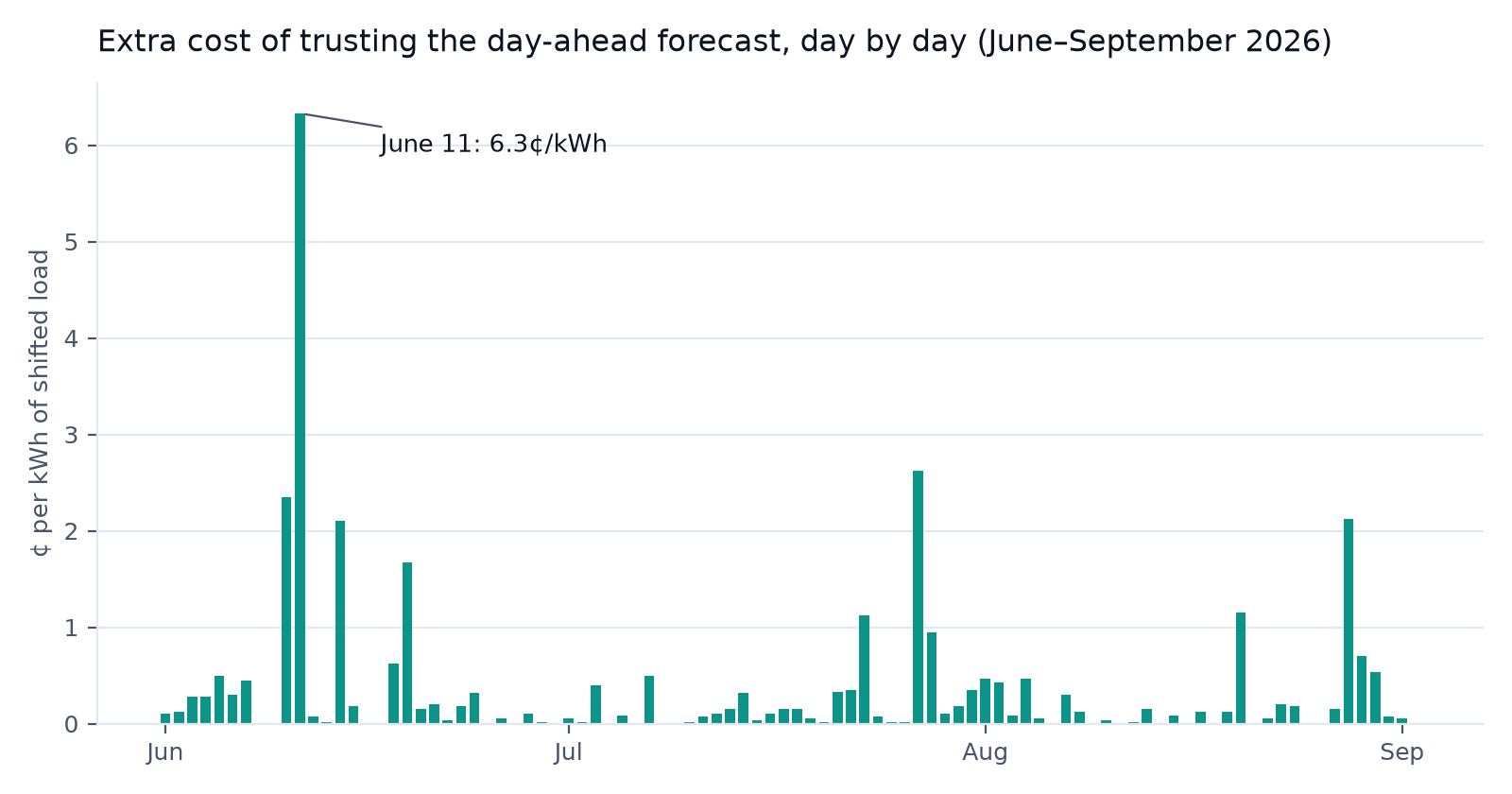
The five worst days (~6% of the time) carried 48% of the whole summer’s forecast-trusting cost. The worst ten (~12%) carried 65%. This is not a rate that quietly overcharges you every day; it is a rate that is honest most of the time and wrong in bursts.
What we’re doing with this information
Two things, both driven by what the measurement showed.
First, improved accounting. Savings math for hourly-priced homes should use the price you were billed, not the forecast price. We are wiring the settled real-time series into our metrics so any gap stays visible instead of averaged away.
Second, the spike days. We have added new data to predict similar price spikes. It is enough warning for an air conditioner to coast within its comfort band, or an EV charger to pause, until the high prices pass. You still set the limits and we have improved the device response time to get better savings within them.
Planning on the day-ahead curve remains the right default, based on the measurements. The real-time feed is how we can stop the ten bad days from taking back what the other seventy-four saved.
Frequently asked questions
Does ComEd bill Hourly Pricing customers the day-ahead price or the real-time price?
The real-time price. Each hour you are billed the average of that hour’s twelve 5-minute PJM prices for the ComEd zone. The day-ahead hourly prices are a forecast of those prices, and ComEd’s own site notes they are informational only. Most hours the two land close together; the difference shows up on days when the real-time market spikes past what the forecast expected.
How different are ComEd’s day-ahead and real-time prices in practice?
We compared every hour from June 1 to September 3, 2026. The typical hour was close: the median gap was 0.7¢/kWh and the two series correlated at 0.76. The tail was not as close. Ninety-two hours settled at 14¢/kWh or more, and the day-ahead forecast had priced almost half of them below 14¢. The single largest miss was July 3 at 5 p.m.: forecast 24.6¢, billed 120.3¢.
Is it still worth scheduling appliances around the day-ahead curve?
Yes. On most days the day-ahead curve ranks the cheap and expensive hours well: shifting four hours of load into the forecast’s cheapest hours cost a median of just 0.12¢/kWh more than a perfect pick, and on our homes the optimized schedules still bought power at a price lower than the all-hours average even when billed at real-time rates. The forecast earns its keep 76 days out of 84. The remaining days are why we are now tracking the real-time feed too.
Related reading: ComEd Hourly Pricing: turning daily wholesale rates into savings · ComEd’s Delivery Time-of-Day pricing · ComEd Peak Time Savings